

A portfolio can look healthy precisely when its risk is becoming harder to see. A token balance may rise, a lending position may continue earning yield, and a wallet dashboard may report a reassuring total value while the underlying exposure is becoming more concentrated, less liquid, or dependent on a fragile smart contract. The counterintuitive lesson is that portfolio tracking is not the same as risk assessment. Tracking records what can be observed; assessment asks what could fail, how losses might propagate, and whether the owner could respond in time.
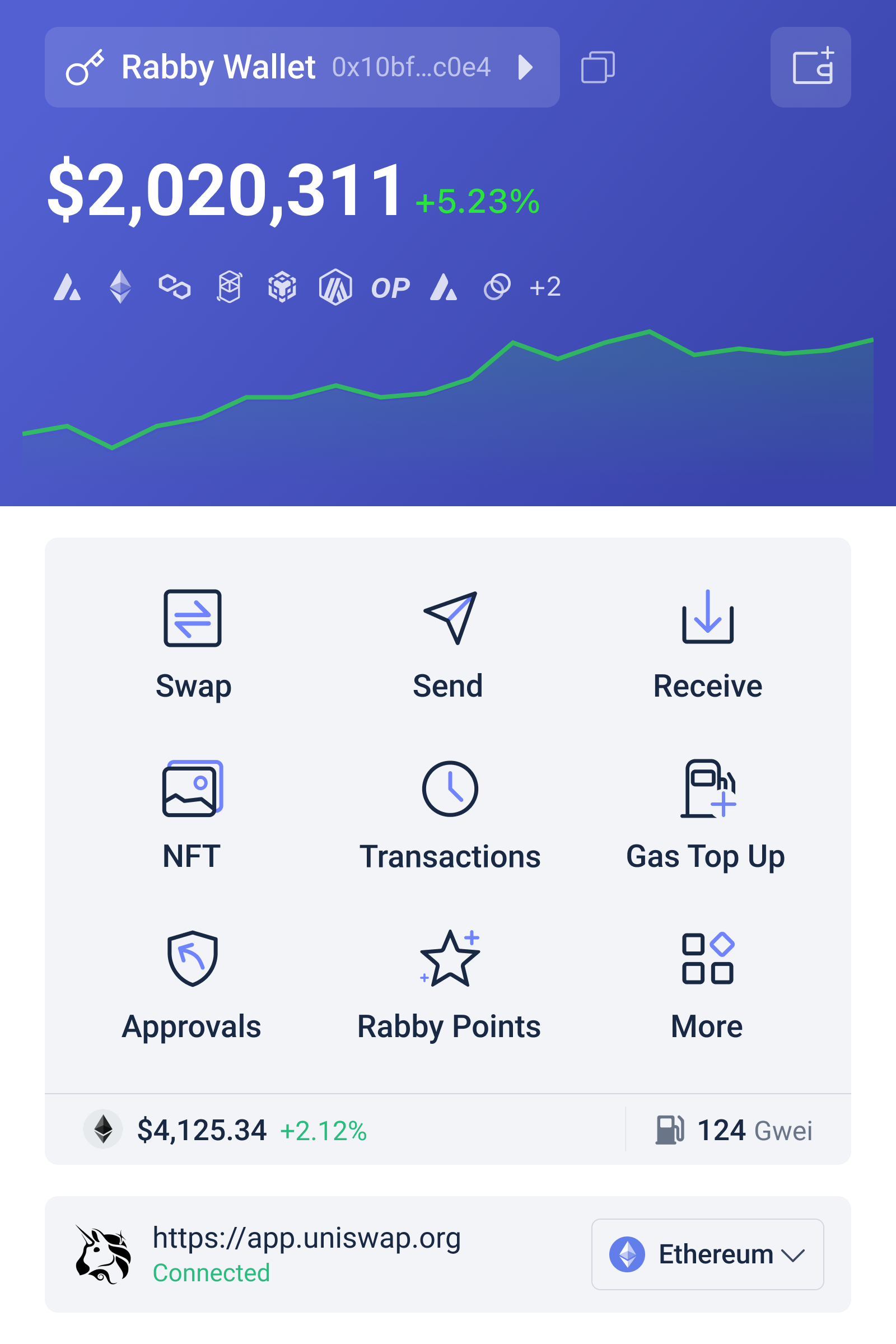
For US-based DeFi users, this distinction matters because on-chain portfolios often span Ethereum and multiple EVM-compatible networks, decentralized exchanges, lending markets, liquid-staking systems, bridges, and governance tokens. An advanced wallet such as rabby wallet can make transaction context and asset visibility more understandable, but no interface can remove market, protocol, liquidity, or operational risk. The useful question is not whether a wallet makes DeFi safe. It is whether it helps the user form a more accurate model before signing.
The first misconception: a portfolio total is not a risk measure
A portfolio tracker usually answers a narrow question: what assets and positions appear to belong to this address, and what are they worth according to available price data? That is valuable, especially when assets are distributed across chains. Yet a single dollar total compresses several different dimensions into one number. It may hide whether the portfolio is diversified by economic exposure, whether positions can be exited without severe slippage, and whether reported prices come from deep markets or thin trading activity.
Consider a wallet holding a stablecoin, a liquid-staking token, a governance token, and a position in an automated market maker. The display may show four assets, but the economic risks could be linked. The stablecoin might lose its peg; the liquid-staking token might trade below its reference asset; the governance token might depend on the same protocol’s revenues; and the liquidity position might suffer impermanent loss when prices diverge. Counting line items would suggest diversification. Examining their failure modes may reveal concentration.
A more useful mental model separates portfolio value from portfolio vulnerability. Value is an estimate at a particular time. Vulnerability concerns the conditions under which that estimate stops being reliable. Those conditions include price gaps, network congestion, oracle errors, contract exploits, bridge failures, frozen withdrawals, wallet compromise, and the practical inability to obtain a favorable exit.
How transaction simulation contributes to risk assessment
Transaction simulation is best understood as a pre-flight inspection, not a guarantee. Before a user confirms a transaction, a simulation can help indicate the likely changes to balances, token approvals, assets received, and assets spent. This is particularly useful because the human-readable intention—“swap one token for another” or “deposit collateral”—does not always reveal the contract-level effects.
The mechanism matters. A decentralized application may request an approval that allows a contract to spend a token later. A swap may route through several contracts and produce a result that differs materially from the interface’s headline description. A malicious or compromised application may attempt to transfer unrelated assets, alter permissions, or interact with a contract that the user did not recognize. Simulation can expose suspicious expected outcomes before a signature is produced, turning an opaque signing moment into an opportunity for inspection.
There is an important boundary condition. A simulation describes what the transaction appears likely to do under a particular blockchain state and execution environment. State can change before confirmation. A contract can behave differently under conditions not captured by the simulation, and an honest-looking result does not establish that the protocol itself is economically sound. Simulation is therefore strongest against certain classes of signing mistakes and deceptive transaction behavior; it is weaker against market risk, governance risk, hidden upgrade authority, and vulnerabilities that do not manifest in the simulated path.
This distinction corrects a common misconception: security warnings are not a substitute for judgment. They are evidence. The user still has to ask whether the recipient contract is appropriate, whether the approval is necessary and limited, whether the position has a credible exit, and whether the expected return compensates for the risks being accepted.
Portfolio tracking across EVM chains: visibility versus comparability
Multi-chain visibility is useful because fragmented information creates its own operational risk. A user who forgets collateral on one network, overlooks a small approval on another, or misreads a bridged asset can make decisions using an incomplete balance sheet. A wallet designed to work across Ethereum and EVM chains can provide a more coherent view of addresses, assets, and activity.
However, aggregation introduces a subtle analytical problem: assets may be visible together without being economically comparable. A dollar-denominated estimate can make a token on a deep US-dollar market appear equivalent to a token on a thin market. It can also treat a bridged representation as interchangeable with an asset held natively, even though the two may depend on different custodians, bridge contracts, or redemption mechanisms.
For that reason, advanced portfolio tracking should classify positions by dependency rather than merely by symbol. Ask what each asset depends on: a market maker, an issuer, an oracle, a bridge, a validator set, a lending pool, or a particular chain. Two tokens with different names may share a dependency, while two tokens with similar price behavior may have very different redemption risks.
A practical risk map
A reusable review can begin with five questions. First, what is the asset’s direct market exposure? Second, how much liquidity is available during stress rather than during normal conditions? Third, which contracts or intermediaries must function for the position to retain value? Fourth, what permissions has the wallet granted? Fifth, how quickly can the user reduce exposure if conditions deteriorate?
This framework is more informative than a simple allocation chart. It connects the portfolio’s visible composition to its failure pathways. A position that represents only a small percentage of total value may still deserve attention if it has unlimited approval rights or depends on a newly deployed contract. Conversely, a volatile asset may be manageable when its size is deliberately limited and its exit route is clear.
Security features reduce some risks, not all risks
Wallet security features can reduce the probability of a costly human error. Clear transaction previews, warnings about suspicious interactions, approval visibility, and network-aware asset displays are practical defenses against confusion. They are especially valuable in DeFi, where users routinely interact with contracts rather than with a single regulated intermediary.
But risk reduction is not risk elimination. A wallet cannot determine with certainty whether a protocol’s economic assumptions will survive a bank-run-style withdrawal event. It cannot guarantee that an oracle will remain accurate during extreme volatility. It cannot make an illiquid token liquid, or transform a risky yield strategy into a low-risk savings product. Nor can it recover a seed phrase that has been exposed or a transaction that was intentionally confirmed after a warning.
The trade-off is therefore one of attention and control. More information can improve decisions, but excessive alerts can produce warning fatigue. If every interaction looks urgent, users may learn to approve warnings reflexively. Effective risk assessment requires focusing on material changes: unexpected recipients, unusual approvals, unfamiliar contracts, large balance movements, and transactions that create durable permissions.
What to monitor after the transaction
Risk assessment does not end at signing. A portfolio can change without a new manual transfer from the user. Lending health factors may deteriorate as collateral prices move. Liquidity positions may become more exposed to one side of a market. Token approvals may remain active after a position is closed. A bridge or protocol may experience an incident while the assets continue to appear normally in the wallet.
Post-transaction monitoring should therefore combine balances with state. Review open permissions, debt and collateral relationships, chain-specific positions, and the liquidity of the assets shown. Compare the current portfolio with the intended strategy: if the plan was to hold a modest exposure, has repeated compounding or reward distribution quietly increased it? If the plan was to maintain a cash-like reserve, is that reserve actually dependent on a depegging-prone instrument?
Recent messaging around Rabby emphasizes use across Ethereum and EVM chains and highlights a simple, fast, security-oriented experience. The practical implication is conditional rather than promotional: if multi-chain support and transaction context help users inspect more of their activity in one place, they may improve the quality of routine checks. The benefit depends on whether users act on that information and whether the underlying data remains complete and correctly interpreted.
FAQ
Does portfolio tracking show my true net worth?
Not necessarily. It may omit liabilities, positions represented by complex contracts, assets on unsupported networks, unclaimed obligations, or tokens whose displayed price is unreliable. Treat the total as an estimate and reconcile it with debt, liquidity, permissions, and exit constraints.
Does transaction simulation prove that a transaction is safe?
No. It can reveal likely balance changes and suspicious permission requests, but it cannot guarantee protocol solvency, future market conditions, contract integrity, or protection from a compromised device. Use simulation as one layer in a broader review.
What is the most useful portfolio risk question?
Ask what must remain true for each position to retain value and remain liquid. This shifts attention from labels and reported returns toward dependencies, permissions, market depth, and realistic exit conditions.
The central lesson is simple but easy to neglect: a wallet interface is an instrument for observation, not an oracle of safety. Portfolio tracking tells you where exposure appears to be; transaction simulation helps clarify what a proposed action may do; risk assessment connects those facts to failure modes and decisions. For DeFi users, that connection is where security becomes practical. The strongest workflow is not “check the balance and approve,” but “map the exposure, inspect the transaction, question the dependencies, and keep watching after execution.”
